AP Chem Score Calculator 2026
Estimate your AP Chemistry score using realistic MCQ and FRQ weighting.
Section I – Multiple Choice
FRQ 1 (Long – 10)
FRQ 2 (Long – 10)
FRQ 3 (Long – 10)
FRQ 4 (Short – 4)
FRQ 5 (Short – 4)
FRQ 6 (Short – 4)
FRQ 7 (Short – 4)
Preparing for AP Chemistry is not just about memorizing formulas or solving practice problems. One of the biggest questions students carry throughout the year is simple but stressful:
“What AP score am I actually heading toward?”
That’s exactly where the AP Chem Score Calculator 2026 by aitoolswork helps. This tool is designed to give you a clear, realistic estimate of your AP Chemistry score based on how the exam is actually structured — not guesswork, not inflated promises.
Whether you’re weeks away from the exam or just finished a practice test, this calculator helps you understand where you stand and what to focus on next.
Table of Contents
What This AP Chem Score Calculator Actually Does
This calculator estimates your predicted AP score (1–5) by using:
- Real AP Chemistry exam sections
- Proper weighting between MCQs and FRQs
- Individual FRQ inputs (not vague totals)
- Conservative, student-safe score ranges
Instead of giving you a single number without context, it shows:
- Your MCQ weighted score
- Your FRQ weighted score
- Your total composite score
- Your predicted AP score
That clarity matters — especially in a subject as demanding as AP Chemistry.
How the AP Chemistry Exam Is Structured (2026 Format)
To understand your score, you first need to understand how the exam itself works.
Section I: Multiple Choice (MCQs)
- 60 questions
- 90 minutes
- 50% of your total score
These questions test:
- Chemical reactions and stoichiometry
- Atomic structure and periodic trends
- Thermodynamics and kinetics
- Equilibrium and acids–bases
Every correct answer counts. There is no guessing penalty, which means smart guessing can still work in your favor.
Section II: Free Response Questions (FRQs)
- 7 total questions
- 105 minutes
- 50% of your total score
FRQs are split into two types:
Long FRQs
- 3 questions
- 10 points each
Short FRQs
- 4 questions
- 4 points each
These questions test how well you can explain chemical reasoning, not just calculate numbers. Partial credit plays a big role here, which is why FRQs often decide whether a student gets a 4 or a 5.
How AP Chemistry Scoring Works (Simple Explanation)
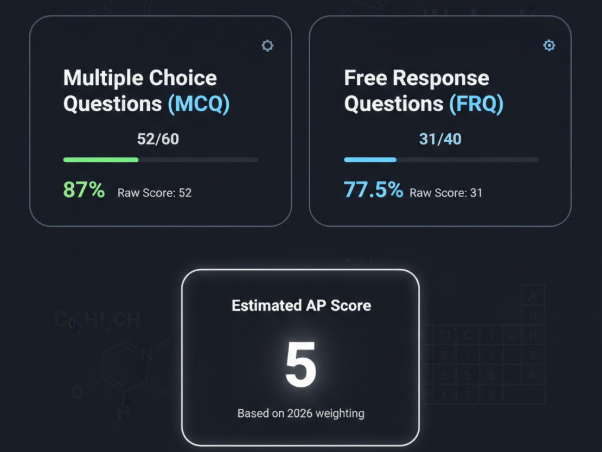
The College Board doesn’t release an exact formula, but the overall process works like this:
- MCQs are counted and scaled to 50 points
- FRQs are scored and scaled to 50 points
- Both sections are combined into a composite score out of 100
- That composite score is converted into an AP score from 1 to 5
The AP Chem Score Calculator 2026 follows this same logic so your estimate stays realistic.
How This Calculator Calculates Your Score
Here’s what happens behind the scenes:
- MCQ score → converted to a 50-point scale
- FRQ score (out of 46 raw points) → converted to a 50-point scale
- Both are added → composite score (0–100)
From there, the calculator predicts your AP score using safe and conservative score ranges, similar to what real students experience each year.
This approach avoids false confidence — which is something many low-quality calculators get wrong.
What Is a “Good” AP Chemistry Score?
A “good” score depends on your goals, but here’s a practical breakdown:
AP Score 5
- Indicates strong college-level mastery
- Often earns college credit
- Typically requires solid performance in both MCQs and FRQs
AP Score 4
- Still excellent
- Accepted by many colleges
- Often achieved by students who are consistent but may miss a few FRQ points
AP Score 3
- Considered passing
- May earn credit at some institutions
- Shows you understand the fundamentals
AP Score 1–2
- Doesn’t mean failure
- Usually indicates gaps in content or timing
- Very fixable with targeted practice
The key takeaway: FRQs matter more than most students think.
Why FRQ Breakdown Matters (And Why Most Tools Get This Wrong)
Many calculators only ask for a total FRQ score. That hides important details.
This calculator uses individual FRQ inputs because:
- Long FRQs carry more weight
- Weaknesses become visible
- Your score estimate becomes more accurate
That’s one of the reasons aitoolswork calculators tend to outperform generic tools.
If you’ve used our
AP World History Score Calculator or APUSH Score Calculator, you’ll notice the same student-first logic applies here too.
How Students Can Improve Their AP Chem Score
If your predicted score isn’t where you want it yet, that’s not bad news — it’s useful information.
Here’s how to move your score up efficiently:
Improve MCQs
- Practice under timed conditions
- Focus on unit patterns, not memorization
- Review why an answer is wrong, not just which one is right
Improve FRQs
- Write clear reasoning, even if calculations are messy
- Show units and logic — partial credit matters
- Practice explaining chemical concepts in words
One or two extra FRQ points can easily push a composite score from a 3 to a 4.
When Should You Use This Calculator?
This tool is especially helpful:
- After full-length practice exams
- Before AP exam registration decisions
- During final revision weeks
- To track improvement over time
Use it as a feedback tool, not a prediction of destiny.
Progress matters more than the number.
Why Students Trust aitoolswork Calculators

aitoolswork isn’t built to chase traffic. It’s built to earn trust.
Our calculators focus on:
- Accuracy over hype
- Clear structure over clutter
- Motivation without false promises
If you’re using multiple AP tools, you may also find value in:
Each tool follows the same logic and UI, so nothing feels confusing or inconsistent.
Final Thought for AP Chemistry Students
AP Chemistry is hard — and that’s okay.
What matters is not where you start, but how clearly you understand where you are and what to do next.
The AP Chem Score Calculator 2026 gives you that clarity — without pressure, without exaggeration.
Use it. Learn from it. Improve steadily.
Is this calculator officially from College Board?
No. This is an independent estimate based on publicly known exam structure and scoring trends.
Can this calculator guarantee my AP score?
No calculator can guarantee an exact score, but this one provides a realistic and safe estimate.
Are FRQs more important than MCQs in AP Chemistry?
They’re equally weighted, but FRQs often make the biggest difference between score levels.
What score should I aim for to get a 4 or 5?
Most students need a composite score above the mid-60s for a 4 and above the low-70s for a 5.
Can I use this calculator for older AP Chem exams?
Yes. The exam structure has remained consistent enough for accurate estimates.