Preparing for an AP history exam can feel overwhelming, especially when students are unsure how practice test scores translate into real AP results. Many students complete full-length practice exams but still struggle to answer one key question: Am I actually on track for a passing or high score?
This is where understanding AP test scoring—and using tools like an ap world test calculator—becomes essential. Instead of guessing, students can analyze performance patterns, identify weak areas, and plan smarter study strategies for AP history exams.
Table of Contents
What Does an AP World Test Calculator Actually Do?
An AP world test calculator helps students convert raw practice test results into an estimated AP score range. Rather than focusing only on the number of questions answered correctly, these tools account for exam structure and weighting.
For AP history exams, calculators typically evaluate:
- Multiple-choice accuracy
- Free-response performance
- Section weight distribution
- Historical scoring trends
This approach gives students a clearer picture of how practice scores align with official AP expectations.
Why AP History Exams Are Harder to Judge Than Other AP Subjects
AP history exams—especially World History and U.S. History—require more than memorization. They test historical reasoning, document analysis, and argumentation skills.
Students often misjudge performance because:
- Essays feel “good” but lack rubric alignment
- Multiple-choice questions reward contextual understanding
- Partial credit plays a major role in FRQs
Because of this complexity, raw scores alone rarely reflect actual readiness.
Understanding How AP World History Scores Are Built

AP World History scores are based on a weighted system that balances objective and written performance.
Students are assessed through:
- Multiple-choice questions (MCQs)
- Short-answer questions (SAQs)
- Document-based questions (DBQs)
- Long essay questions (LEQs)
Each section contributes differently to the final score, which is why calculators that mirror this structure provide more realistic estimates than simple percentage calculations. For official reference, these score weightings align with the College Board’s published criteria outlined in the official AP World History exam scoring guidelines. Using realistic scoring models, students can estimate your AP World History score before the official exam.
How APUSH Scoring Differs From AP World History
While APUSH and AP World History follow similar frameworks, scoring expectations differ in emphasis.
APUSH places greater weight on:
- Historical specificity
- U.S.-focused argument development
- Precise evidence usage
AP World History focuses more on:
- Global comparisons
- Long-term historical processes
- Cross-cultural analysis
Using history-specific calculators allows students to account for these differences instead of relying on generic scoring assumptions. Tools that help track AP U.S. History performance are especially useful for students preparing for both AP World and APUSH.
Real Student Examples (Why Calculators Matter)
Example 1: Strong MCQs, Weak Essays
A student consistently scores high on multiple-choice sections but earns average scores on DBQs and LEQs. Despite strong recall, final scores often plateau.
Result:
The calculator reveals that essay improvement would yield the biggest score jump.
Example 2: Average MCQs, Strong Writing
Another student performs moderately on MCQs but excels in document analysis and argument structure.
Result:
Score estimates show potential for a higher final AP score than expected.
These insights help students focus on impactful improvements rather than guessing.
How to Use an AP History Test Calculator Effectively
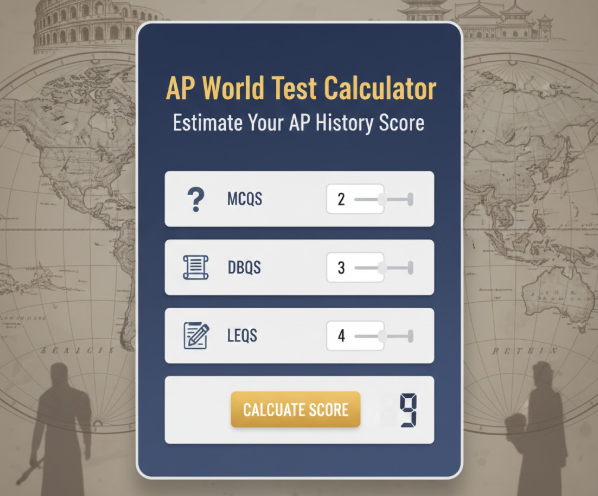
To get the most value from score estimates, students should:
- Use full-length, timed practice exams
- Score essays strictly using official rubrics
- Test multiple score scenarios
- Track trends across several practice tests
Practical Tip
If your score fluctuates widely, consistency—not content knowledge—is likely the issue.
Practical Tip
Essay rubrics matter more than writing speed. Clear structure beats longer responses.
Accuracy and Limitations You Should Know
No AP score calculator and AP World Test Calculator can guarantee official results. Final AP scores depend on yearly scoring curves and human evaluation.
However, calculators are highly reliable for:
- Identifying score ranges
- Tracking improvement
- Highlighting weak sections early
They become less accurate when students overestimate essay quality or rely on a single test attempt.
Common Mistakes Students Make When Evaluating AP History Scores
Students often misinterpret practice results due to:
- Ignoring rubric language
- Overvaluing MCQ performance
- Practicing essays without feedback
- Assuming one test defines readiness
Regular score analysis helps correct these mistakes before exam day.
How Score Tracking Improves AP History Results
Students who understand scoring systems prepare more efficiently. Instead of random practice, they focus on skills that directly affect outcomes.
High-performing AP history students emphasize:
- Thesis clarity
- Evidence-based commentary
- Contextualization
- Balanced MCQ and FRQ practice
This strategy consistently leads to better results.
Final Thoughts
AP history exams reward strategy as much as knowledge. When students understand how scores are calculated and use estimation tools responsibly, preparation becomes more focused and less stressful.
A test calculator won’t take the exam for you—but it can help you prepare smarter, target weaknesses, and walk into exam day with confidence.
How accurate are AP history score calculators?
They provide realistic estimates based on past scoring patterns but cannot guarantee final scores. Most AP history score calculators are best used to identify score ranges rather than exact outcomes.
Who should use these tools?
Students preparing for AP World History or AP U.S. History exams.
How often should scores be recalculated?
After every full-length practice exam.
Do calculators replace teacher feedback?
No. They support preparation but do not replace rubric-based evaluation.
Why do different calculators give different results?
Some tools use outdated scoring models or ignore essay weighting.
